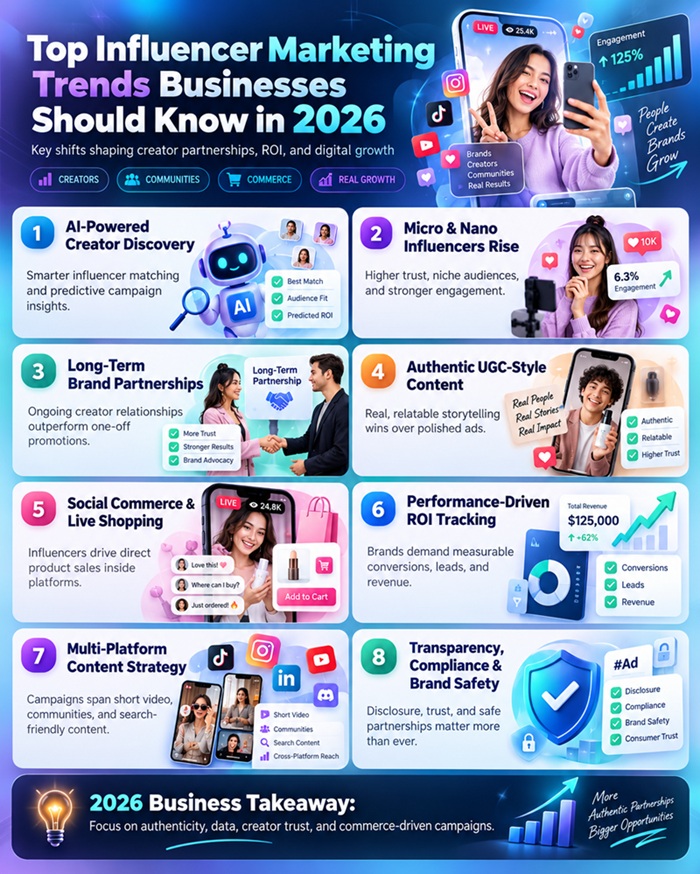
Top Influencer Marketing Trends Businesses Should Know in 2026
Influencer marketing has moved far beyond sponsored posts and celebrity endorsements. In 2026, creators are becoming an important part of how businesses build awareness, generate trust, introduce products, and influence purchasing decisions.
Consumers now discover brands through short-form videos, creator recommendations, social media searches, live streams, and online communities. At the same time, businesses are becoming more careful about where they spend their marketing budgets. Follower count alone is no longer enough. Brands increasingly want authentic engagement, relevant audiences, measurable conversions, and long-term value.
Artificial intelligence is also changing how companies discover creators, plan campaigns, analyze content, and measure results. These developments are making influencer marketing more sophisticated and performance-focused.
Here are some of the most important influencer marketing trends businesses should know in 2026.
1. Micro and Nano Influencers Are Becoming More Important
One of the biggest changes in influencer marketing is the growing importance of smaller creators.
Micro and nano influencers may have smaller audiences than celebrities or major internet personalities, but their communities can be highly focused and engaged.
For businesses targeting a particular city, profession, hobby, age group, or product category, a smaller creator with the right audience may offer more useful exposure than a celebrity with millions of followers.
Industry research in 2026 continues to highlight the growing share of influencer spending going toward micro and nano creators.
Why Businesses Are Working With Smaller Creators
Smaller influencers often communicate with followers in a more personal and conversational way.
Their recommendations may feel closer to advice from a knowledgeable friend than a conventional advertisement. This can make them particularly useful for niche products and local businesses.
Brands can also work with several smaller creators instead of depending on a single major influencer.
Audience Relevance Matters More Than Audience Size
Businesses should therefore evaluate creators based on factors such as:
- Audience demographics
- Content relevance
- Engagement quality
- Brand compatibility
- Previous collaborations
- Conversion potential
The biggest account is not automatically the most useful account.
2. AI Is Becoming Part of Influencer Marketing Workflows
Artificial intelligence has become one of the most important technologies influencing digital marketing in 2026.
Brands and agencies are increasingly using AI-powered tools for tasks such as creator discovery, campaign planning, audience analysis, performance reporting, caption development, content ideas, and trend identification.
Creators are also incorporating AI into their workflows for brainstorming, research, editing, and content planning.
AI Can Make Creator Discovery More Efficient
Finding suitable influencers manually can require hours of research.
AI-driven systems can help businesses analyze large numbers of creator profiles and identify potential partners based on audience characteristics, content themes, engagement patterns, and campaign requirements.
This does not eliminate the need for human judgment.
Brands still need to review whether a creator’s personality, communication style, reputation, and values are suitable for the partnership.
Human Authenticity Still Matters
AI can improve efficiency, but authenticity remains central to influencer marketing.
Consumers follow creators because of their perspectives, personalities, experiences, and communities. Businesses that automate too much risk making creator content feel generic.
The strongest approach is likely to combine technology-driven efficiency with genuine human creativity.
3. Short-Form Video Continues to Shape Product Discovery
Short-form video remains a major part of social media culture in 2026.
Platforms and formats such as Instagram Reels and YouTube Shorts have changed how quickly people discover products, trends, businesses, and creators.
Instead of reading a long product description, consumers can see how a product works within seconds.
Creators Are Making Products Easier to Understand
Creator-led video can demonstrate products in real situations.
For example, a beauty creator might show how a cosmetic product looks when applied, while a technology creator can demonstrate the features of a new device.
This combination of entertainment, education, and product demonstration makes short-form video particularly useful for influencer campaigns.
Brands Need Content Designed for Mobile Audiences
Businesses should avoid treating short videos as smaller versions of traditional advertisements.
Effective creator videos usually need to capture attention quickly and communicate a clear idea without appearing overly scripted.
Native-looking content often fits social platforms better than highly polished corporate advertising.
4. Influencer Marketing Is Moving Closer to Social Commerce
Social media platforms are increasingly connecting content discovery with shopping.
A consumer can discover a product through a creator, learn about it through a video, follow a product link, and potentially make a purchase with fewer steps than before.
This connection between creators and commerce is an important development for businesses.
Creator Content Can Support the Entire Customer Journey
Influencers are no longer useful only for brand awareness.
Creator campaigns can contribute at several stages, including:
- Product discovery
- Consideration
- Reviews
- Product demonstrations
- Website visits
- Lead generation
- Purchases
In markets such as India, video-led discovery, creators, AI and conversational commerce are increasingly becoming interconnected parts of the online shopping journey.
Businesses Should Reduce Friction Between Content and Purchase
When businesses run creator campaigns, the next step should be easy for consumers.
Relevant landing pages, product links, promotional codes, messaging options, and shopping integrations can help turn creator interest into measurable business activity.
5. Long-Term Influencer Partnerships Are Replacing One-Off Posts
Another major influencer marketing trend in 2026 is the movement toward longer partnerships.
Historically, many businesses hired creators for a single sponsored post. Today, brands are increasingly considering ongoing relationships with creators who genuinely fit their audience and products.
Repeated Exposure Can Build Familiarity
A single sponsored post may quickly disappear from a user’s feed.
When the same creator discusses a product naturally over several months, the audience has more opportunities to understand the brand.
Long-term relationships can also help creators become more familiar with the company’s products and communicate their benefits more naturally.
Creators Are Becoming Brand Partners
Some businesses are involving creators in:
- Product launches
- Event campaigns
- Product development
- Affiliate programs
- Brand storytelling
- Community building
- Ongoing content series
This represents a shift from treating influencers simply as advertising inventory toward treating creators as strategic marketing partners.
6. Performance-Based Influencer Marketing Is Growing
Businesses are demanding greater accountability from influencer campaigns.
Likes, views, and follower numbers still provide useful information, but they do not always show whether a campaign produced meaningful business results.
As influencer marketing budgets mature, brands are paying greater attention to measurable outcomes.
Businesses Are Tracking More Meaningful Metrics
Depending on the campaign objective, companies may measure:
- Website traffic
- Click-through rates
- Leads
- Sales
- Discount code usage
- Cost per acquisition
- Engagement quality
- Brand searches
- Return on investment
Affiliate links and trackable promotional codes can also help connect individual creators with conversions.
Campaign Goals Should Be Defined Before Selecting Influencers
Businesses should determine what they want to achieve before choosing creators.
A campaign designed for awareness may require different influencers and metrics than a campaign focused on direct sales.
Clear objectives make it easier to evaluate performance accurately.
7. Authentic and Less-Polished Content Is Gaining Attention
Audiences have become familiar with traditional influencer advertising.
Highly scripted promotions can therefore be easier to recognize and ignore.
In response, brands and creators are experimenting with more natural content formats.
Storytelling Is Becoming More Important
Instead of simply holding a product and listing its benefits, creators may introduce products through personal experiences, tutorials, challenges, behind-the-scenes content, or episodic stories.
This approach allows the product to become part of useful or entertaining content.
Creative Freedom Can Improve Influencer Content
Businesses naturally need brand guidelines, but excessively controlling a creator’s script can reduce authenticity.
Creators generally understand the tone and communication style their audiences expect.
Providing clear campaign goals while allowing reasonable creative freedom can result in content that feels more natural to the platform.
8. Regional and Local Creators Are Creating New Opportunities
Influencer marketing is also expanding beyond major cities and English-language content.
Regional creators can help businesses communicate with audiences in local languages and culturally relevant formats.
This trend is especially important in diverse markets such as India.
Local Influence Can Help Brands Enter Specific Markets
A national campaign does not always require national celebrities.
A business entering a particular state or city may benefit from working with creators who already understand that region’s language, culture, consumer behavior, and local trends.
Vernacular Content Can Strengthen Audience Connections
Regional-language content can make marketing feel more accessible and relevant.
Businesses planning influencer campaigns should therefore consider language and geography alongside follower numbers.
9. Employee Creators Are Emerging as Another Form of Influence
Influence does not always need to come from professional social media personalities.
Employees can also become credible voices for organizations.
People working inside a business can share workplace knowledge, product expertise, industry insights, and behind-the-scenes experiences.
Employee-Generated Content Can Humanize a Brand
Corporate accounts often communicate through carefully prepared marketing messages.
Employees can provide a different perspective by showing the people behind the organization.
This approach can be useful in industries where expertise and trust play an important role.
Businesses, however, should establish clear social media guidelines and ensure participation is transparent and appropriate.
10. Transparency and Trust Will Remain Critical
As influencer marketing becomes more professional, audiences are also paying closer attention to sponsored relationships.
Businesses and creators need to communicate partnerships transparently and follow applicable advertising and disclosure requirements.
Trust Is Difficult to Rebuild Once Lost
Misleading claims, undisclosed sponsorships, fake engagement, and poorly matched partnerships can damage both creator and brand credibility.
Businesses should conduct appropriate checks before beginning collaborations and ensure creators understand campaign expectations.
Responsible Influencer Marketing Is Becoming a Business Requirement
Contracts, content approvals, usage rights, disclosure requirements, payment terms, and performance expectations should be clearly documented.
This makes influencer marketing more professional and reduces misunderstandings between brands and creators.
What Businesses Should Do in 2026
The influencer marketing landscape is becoming more mature.
Businesses entering the space should focus less on chasing the largest possible follower counts and more on building a structured creator strategy.
Start by identifying the audience you want to reach and the business result you want to achieve. Then select creators based on relevance, credibility, content quality, and audience fit.
Use technology to improve discovery and measurement, but allow creators enough freedom to produce content that feels genuine.
Businesses should also consider combining several approaches. Micro-influencers can reach niche communities, short-form videos can generate discovery, long-term partnerships can build familiarity, and social commerce tools can help convert attention into action.
Conclusion
Influencer marketing in 2026 is evolving from a simple promotional tactic into a broader business strategy.
Micro and nano influencers are gaining importance, AI is improving campaign workflows, short-form video continues to shape discovery, and social commerce is bringing content closer to transactions. At the same time, brands are demanding better measurement and building longer relationships with creators.
The central theme behind these trends is clear: successful influencer marketing is becoming less dependent on follower numbers and more dependent on relevance, trust, creativity, community, and measurable business outcomes.
Businesses that understand these changes can develop influencer campaigns that are more targeted, authentic, and connected to their broader digital marketing goals.
