










































































































































































































































































































































































































































































































































































































































































































































































































































































































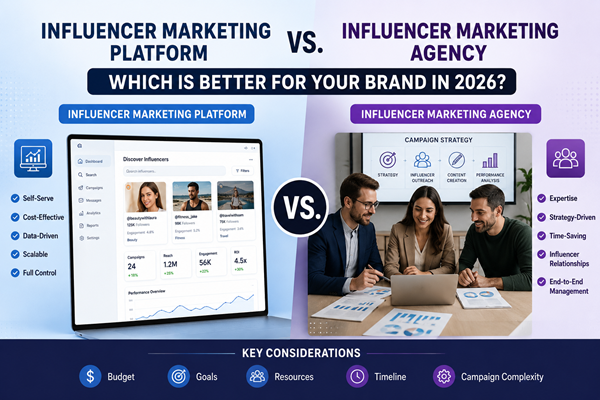
Influencer Marketing Platform vs. Influencer Marketing Agency: Which Is Better for Your Brand in 2026?
If you had asked a marketing executive five years ago how they planned to grow a brand online, the answer would probably have revolved around paid advertising, SEO, email campaigns, and social media. Today, that conversation looks very different. Influencer marketing has evolved from an experimental channel into one of the most influential pillars of modern digital marketing. Brands across industries—from fashion and beauty to SaaS, finance, healthcare, and B2B technology—are investing billions of dollars into creator partnerships because consumers increasingly trust people more than polished advertisements.
Yet, while influencer marketing has become more accessible, it has also become far more complex. Finding creators who genuinely align with a brand’s values, negotiating collaborations, reviewing content, ensuring legal compliance, tracking campaign performance, and calculating return on investment require a level of expertise that many businesses underestimate. As campaigns grow larger, spreadsheets, emails, and direct messages quickly become impossible to manage.
This is why many companies eventually reach a crossroads. Should they invest in an influencer marketing platform that gives them the technology to manage campaigns internally, or should they outsource everything to an influencer marketing agency that handles strategy, creator outreach, execution, and reporting?
It’s a question with no universal answer. The right choice depends on your budget, team size, marketing objectives, industry, campaign frequency, and long-term growth plans. What works perfectly for a global consumer brand may be completely unnecessary for a local startup, while an enterprise software company may require an entirely different approach from an eCommerce retailer.
In this guide, we’ll explore the differences between influencer marketing platforms and influencer marketing agencies, examine the advantages and limitations of each approach, compare costs and ROI, and help you determine which solution is the better investment for your business in 2026.
The Evolution of Influencer Marketing
Influencer marketing has changed dramatically over the past decade. In its early years, campaigns often revolved around celebrities and social media personalities with millions of followers. Brands primarily focused on visibility, believing that larger audiences automatically translated into better results. Over time, however, marketers realized that follower count was only one piece of the puzzle.
Today’s most successful campaigns prioritize authenticity, engagement, audience relevance, and measurable business outcomes. Micro and nano influencers frequently outperform celebrities because their communities are more engaged and their recommendations feel more genuine. At the same time, advances in analytics have made it possible to measure everything from clicks and conversions to customer lifetime value.
This transformation has created demand for specialized tools and services. Brands no longer need someone simply to find influencers—they need solutions that manage entire creator ecosystems, automate repetitive tasks, and deliver actionable insights. This demand has given rise to two distinct approaches: influencer marketing platforms and influencer marketing agencies.
What Is an Influencer Marketing Platform?
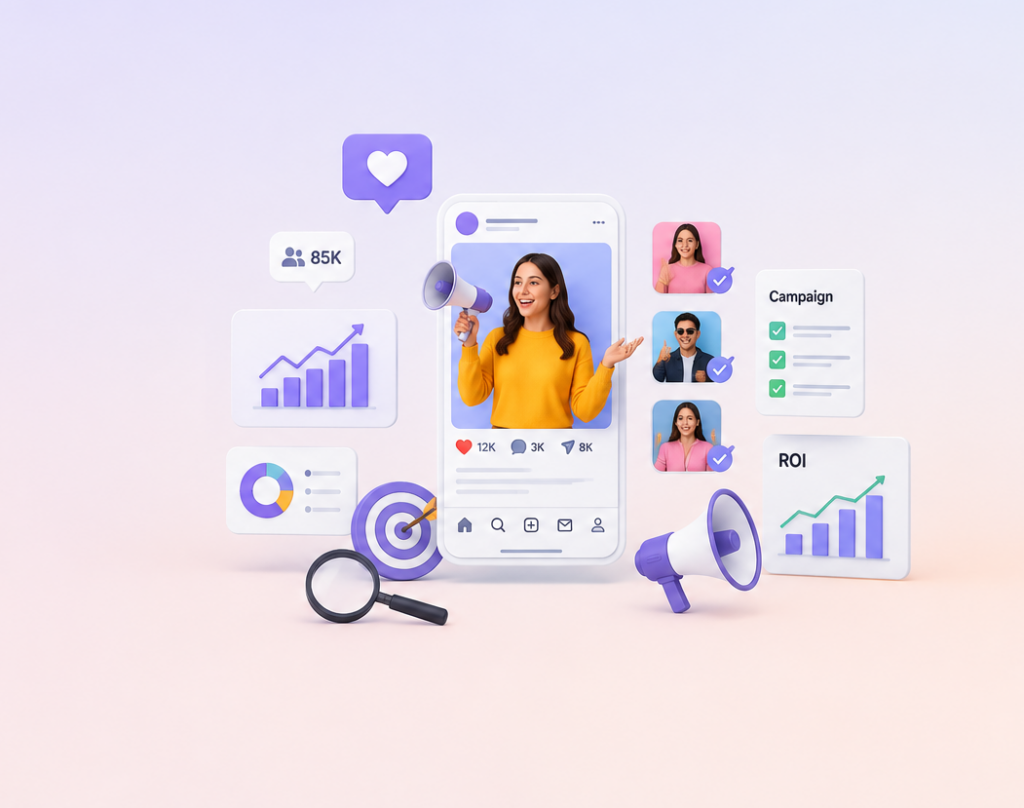
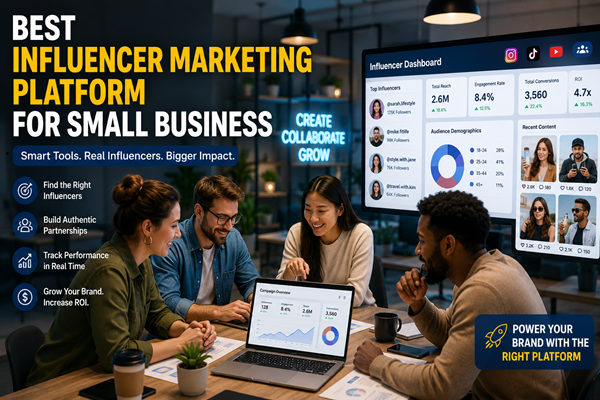
An influencer marketing platform is a software solution designed to help businesses manage influencer campaigns in-house. Think of it as the operating system behind your creator marketing efforts. Rather than relying on scattered spreadsheets or manual outreach, brands can centralize every aspect of influencer management in one place.
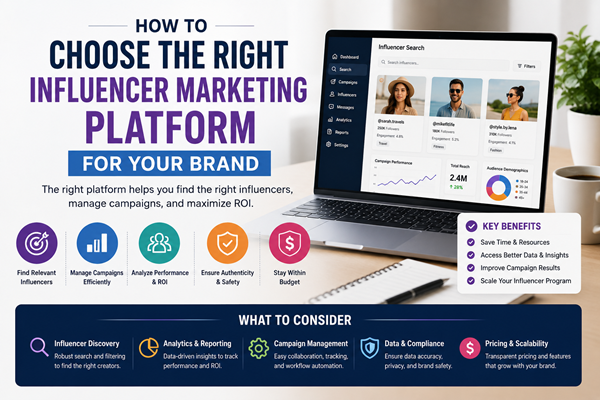
Modern platforms use artificial intelligence and large creator databases to help marketers discover influencers based on niche, audience demographics, engagement rates, location, language, interests, and content style. Beyond discovery, these platforms streamline communication, campaign planning, content approvals, contracts, payments, affiliate tracking, and performance reporting.
What makes influencer marketing platforms particularly attractive in 2026 is their ability to automate repetitive work. Tasks that once required hours of manual effort—such as filtering creators, sending outreach emails, tracking product shipments, or calculating campaign ROI—can now be completed in minutes.
Many leading platforms also integrate directly with eCommerce platforms like Shopify, CRM systems, social media channels, and analytics tools. This creates a unified marketing workflow where influencer campaigns become part of the broader digital marketing strategy rather than operating in isolation.
Perhaps the biggest advantage of using a platform is control. Brands retain ownership of their relationships with creators, maintain access to campaign data, and build internal expertise over time. Instead of depending on an external partner, the marketing team develops its own influencer marketing capabilities.
What Is an Influencer Marketing Agency?
An influencer marketing agency takes a completely different approach. Instead of providing software, an agency provides expertise.
Agencies act as strategic partners responsible for planning, executing, and optimizing influencer campaigns on behalf of their clients. Rather than logging into a dashboard to manage campaigns yourself, you rely on experienced professionals who already understand creator relationships, campaign strategy, negotiation, compliance, and performance analysis.
A full-service influencer agency typically begins by understanding a brand’s objectives, target audience, budget, and positioning. Based on these insights, the agency develops a campaign strategy, identifies suitable creators, negotiates partnerships, manages contracts, oversees content production, coordinates approvals, launches campaigns, and delivers performance reports.
Many agencies also provide creative direction, ensuring that influencer content aligns with brand guidelines while preserving the creator’s authentic voice. This balance between creative freedom and brand consistency is one of the reasons agencies continue to play a valuable role despite the rise of automation.
For businesses without dedicated marketing teams or influencer expertise, agencies offer immediate access to experienced professionals, established creator networks, and proven campaign processes.
Understanding the Fundamental Difference
Although both options help brands run influencer campaigns, their underlying philosophy is very different.
An influencer marketing platform provides technology that enables your team to manage campaigns independently. You remain responsible for strategy, creator relationships, negotiations, and execution, while the software simplifies and automates much of the work.
An influencer marketing agency, on the other hand, provides people rather than technology. The agency’s team handles much of the operational complexity, allowing your internal marketing team to focus on broader business priorities.
In simple terms, a platform gives you the tools to fish, while an agency catches the fish for you.
This distinction has important implications for cost, scalability, flexibility, and long-term marketing capabilities.
1. Cost: Which Option Offers Better Value?
Budget is often the first consideration for businesses evaluating influencer marketing solutions.
Influencer marketing platforms generally operate on monthly or annual subscription models. While enterprise platforms can be expensive, many solutions offer pricing tiers suitable for startups and growing businesses. Once subscribed, brands can run multiple campaigns without paying additional management fees, making platforms increasingly cost-effective as campaign volume grows.
Agencies typically charge through retainers, campaign-based pricing, or a percentage of campaign spend. While this can be advantageous for businesses running occasional campaigns, costs often increase significantly as campaign frequency and complexity expand.
For example, a startup launching one campaign each quarter may find an agency more practical because it avoids hiring internal specialists. Conversely, an eCommerce company running dozens of campaigns every month will likely achieve greater long-term savings by investing in a platform and building internal expertise.
The true cost comparison extends beyond invoices. Businesses should also consider the value of time, internal resources, learning curves, and opportunity costs.
2. Control and Brand Ownership
One of the most overlooked aspects of influencer marketing is relationship ownership.
When brands work through agencies, creator relationships often remain closely tied to the agency itself. If the partnership ends, maintaining continuity with influencers can become challenging.
Using an influencer marketing platform encourages brands to build direct, long-term relationships with creators. Over time, these relationships become valuable business assets that improve campaign authenticity, reduce acquisition costs, and strengthen brand advocacy.
For companies focused on sustainable creator partnerships rather than one-off promotions, retaining ownership of these relationships can become a significant competitive advantage.
3. Scalability in a Growing Creator Economy
The creator economy is expanding rapidly, and many brands now collaborate with hundreds of influencers each year. Managing this scale manually becomes increasingly difficult.
Influencer marketing platforms excel at scalability. Automation allows marketing teams to manage larger campaigns without proportionally increasing workload. AI-powered creator recommendations, workflow automation, payment processing, and reporting enable businesses to expand efficiently.
Agencies also scale well but often require larger budgets and additional coordination as campaigns grow. Businesses may encounter limitations related to communication, approval processes, or agency capacity during peak marketing periods.
For organizations planning aggressive expansion, technology-driven scalability often provides greater flexibility and operational efficiency.
Which Option Is Better for Different Types of Businesses?
There is no single solution that fits every business.
A startup launching its first influencer campaign may benefit from the strategic guidance and experience of an agency. Rather than investing time learning complex campaign management, founders can rely on professionals to avoid common mistakes.
A growing direct-to-consumer brand with an established marketing team may find an influencer marketing platform more valuable. As campaign frequency increases, automation and internal relationship management often generate better long-term returns.
Enterprise organizations frequently adopt hybrid models, combining sophisticated influencer platforms with specialized agencies for major product launches or international campaigns.
B2B companies often prioritize agencies with industry expertise because finding credible thought leaders requires strategic relationship-building rather than simply filtering influencer databases.
Ultimately, the best choice depends less on company size than on internal capabilities, campaign frequency, and long-term marketing objectives.
The Rise of Hybrid Strategies
Increasingly, brands are discovering that the debate isn’t about choosing one option over the other. Instead, many successful organizations combine both approaches.
They invest in influencer marketing platforms to manage daily operations, maintain creator relationships, and centralize campaign data, while partnering with agencies for specialized initiatives such as product launches, international expansion, or high-profile brand collaborations.
This hybrid approach combines technological efficiency with strategic expertise, allowing brands to remain agile while benefiting from professional guidance when needed.
Final Thoughts
Influencer marketing in 2026 is no longer defined by follower counts or viral moments. Success depends on building authentic creator relationships, managing campaigns efficiently, and measuring meaningful business outcomes. Whether you choose an influencer marketing platform or an influencer marketing agency, the ultimate goal remains the same: connecting your brand with audiences through trusted voices.
If your business values control, scalability, automation, and long-term relationship ownership, an influencer marketing platform is often the stronger investment. If you lack internal expertise, require strategic guidance, or run occasional campaigns, an experienced influencer marketing agency can deliver faster results with less operational complexity.
For many modern brands, however, the most effective strategy lies somewhere in between. Technology provides the infrastructure, while expert guidance adds creativity, strategic direction, and executional excellence. As influencer marketing continues to mature, the businesses that successfully blend these strengths will be best positioned to build lasting relationships with creators—and with the customers who trust them.